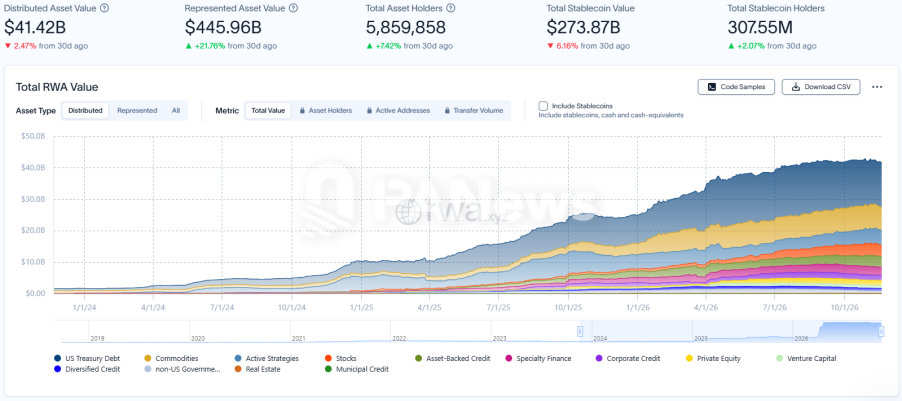
A weekly RWA report covering November 13–20, 2026, described a split in stablecoin activity: market value and transfer volume fell compared with the same point a month earlier, while measures of user participation rose. The period also brought developments in tokenized deposits, stablecoin payments and tokenized fund settlement.
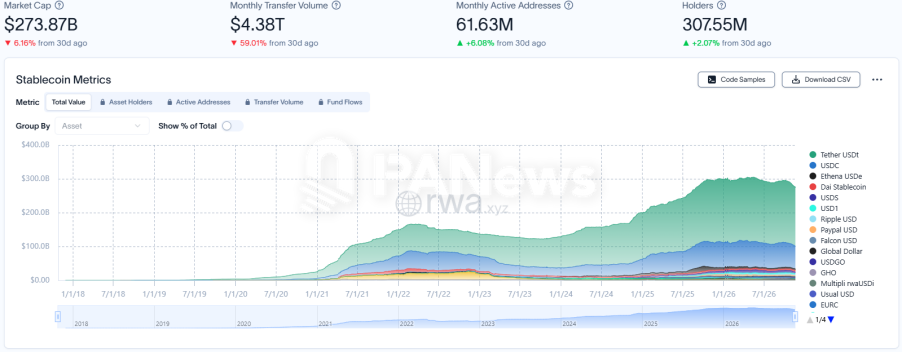
Stablecoin market snapshot
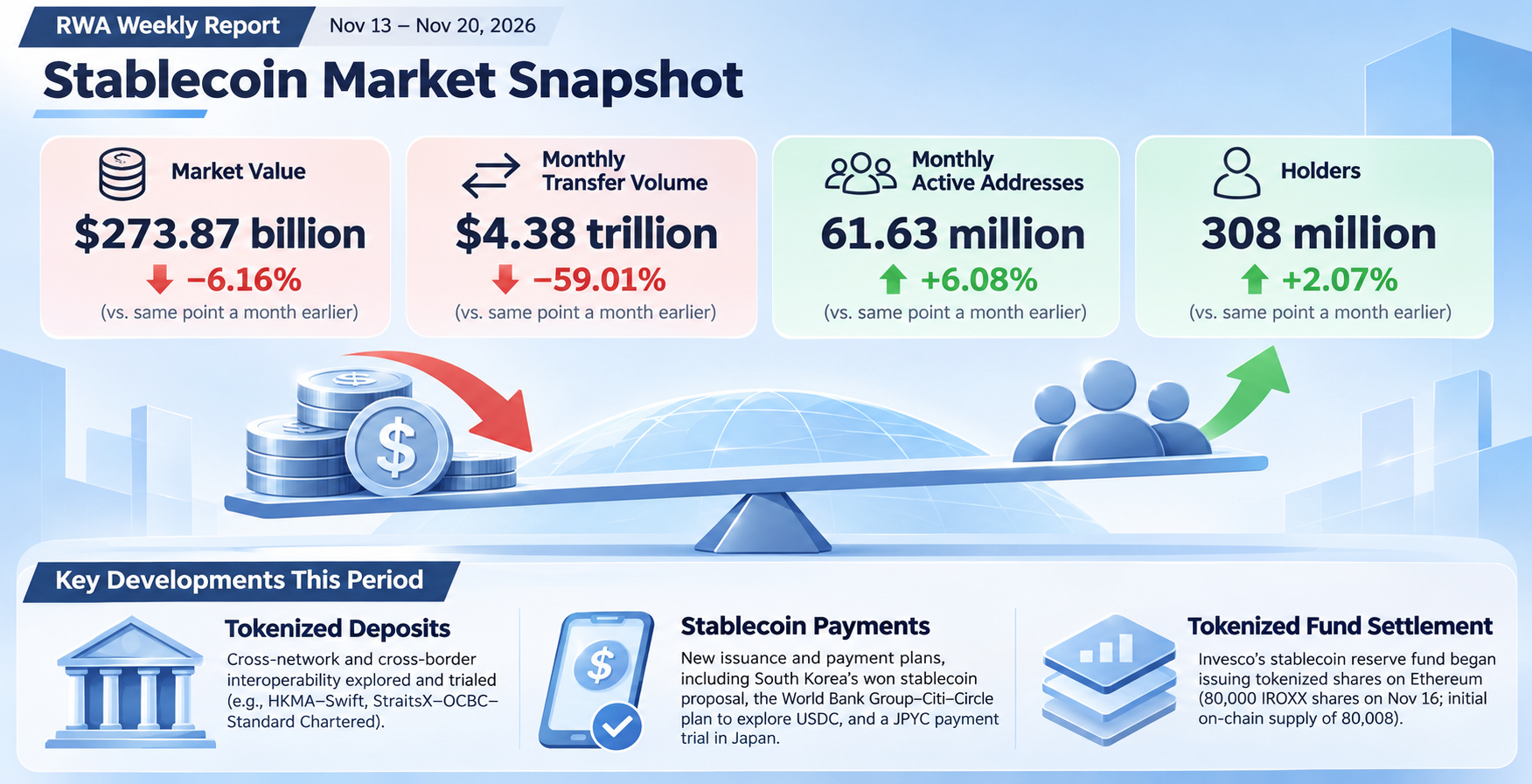
Citing RWA.xyz data as of November 20, the report put total stablecoin market value at $273.87 billion, down 6.16% from the same point a month earlier. Monthly transfer volume was $4.38 trillion, down 59.01% on that basis. Monthly active addresses rose 6.08% to 61.63 million, while the number of holders increased 2.07% to 308 million.
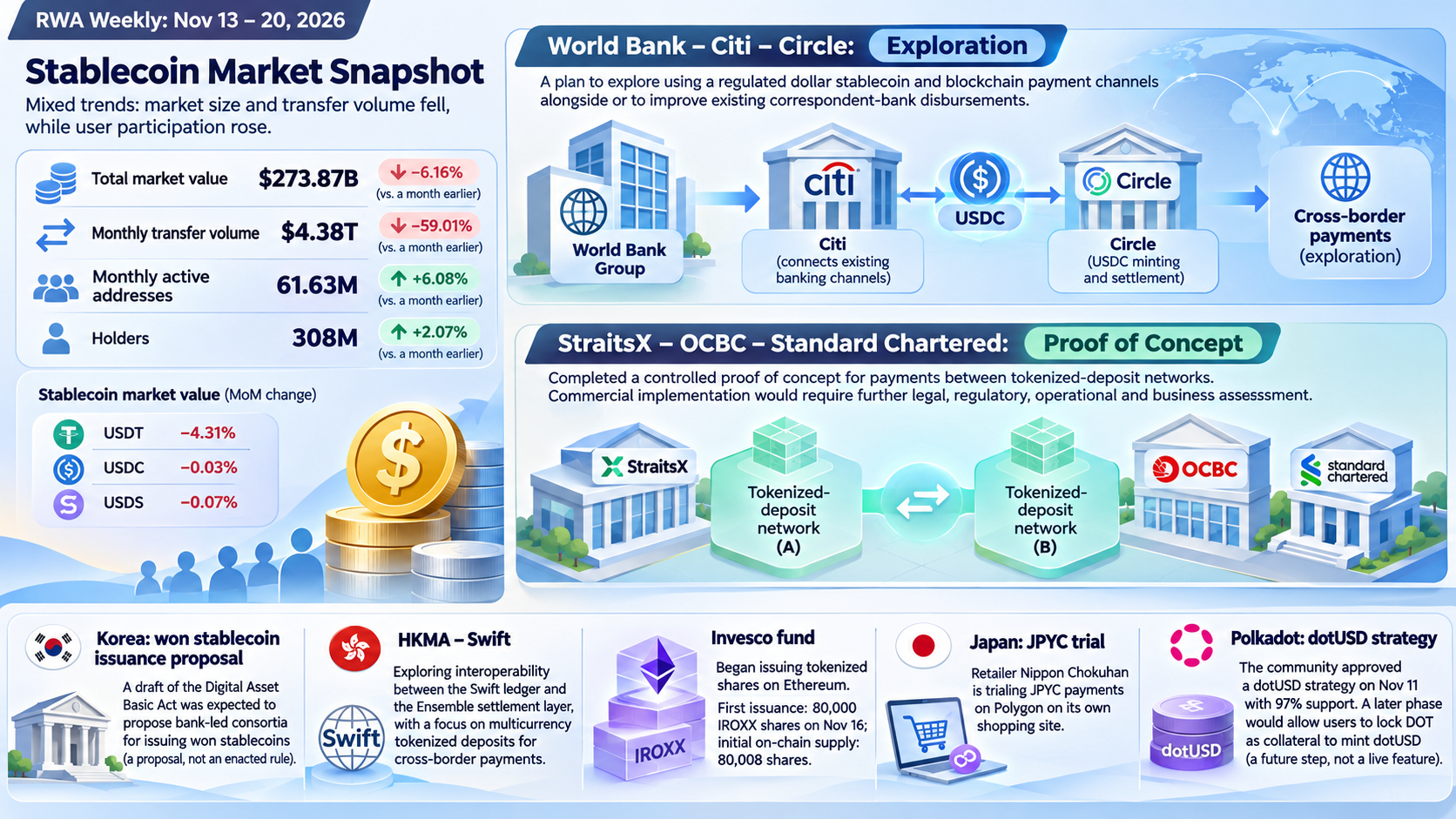
Those measures describe different aspects of the market: more active addresses and holders did not translate into higher aggregate transfer volume during the reported period. The report also recorded month-on-month market-value declines of 4.31% for USDT, 0.03% for USDC and 0.07% for USDS.
Issuance and payment plans
According to the report, a draft of South Korea’s Digital Asset Basic Act was expected to propose bank-led consortia for issuing won stablecoins. That was a proposal, not an enacted issuance rule. A financial regulator cited in the report said stablecoin use in electronic payments could require obligations under the country’s Electronic Financial Transactions Act, including protections for funds used for top-ups and settlement.
The World Bank Group announced a plan with Citi and Circle to explore using a regulated dollar stablecoin and blockchain payment channels alongside or to improve its existing correspondent-bank disbursement arrangements. Under the proposed arrangement, Citi would connect existing banking channels, while Circle would handle USDC minting and settlement. The group said its FundsChain platform already covered more than 350 projects in 96 countries; the report did not say USDC disbursements had begun across those projects.
In Japan, retailer Nippon Chokuhan was trialing JPYC payments on Polygon on its own shopping site. Separately, the Polkadot community approved a dotUSD strategy on November 11 with 97% support. A later phase would allow users to lock DOT as collateral to mint dotUSD; that mechanism was described as a future step, not a live feature.
Tokenized deposits and funds
The Hong Kong Monetary Authority announced on November 16 that it was working with Swift and banks to explore interoperability between the Swift ledger and the settlement layer of its Ensemble project, with a focus on multicurrency tokenized deposits for cross-border payments. In Singapore, StraitsX, OCBC and Standard Chartered completed a controlled proof of concept for payments between tokenized-deposit networks; the parties said commercial implementation would require further legal, regulatory, operational and business assessment.
The report also said Invesco’s stablecoin reserve fund had begun issuing tokenized shares on Ethereum. Citing Etherscan, it recorded a first issuance of 80,000 IROXX shares on November 16 and an initial on-chain supply of 80,008 shares. Under the fund prospectus as described in the report, declared daily net investment income is reinvested in newly minted shares unless an investor elects cash. Superstate CEO Robert Leshner described the fund as compliant with the GENIUS Act; that characterization is attributed to him, not presented here as an independent legal finding. The fund’s tokenized shares are distinct from a stablecoin or a guarantee of redemption.