A stablecoin payment can pass through a token transfer, a fiat conversion and a bank settlement without all three activities falling under one licence. In an analysis published on 16 November 2026, Shao Jiadian of Mankun Blockchain Legal Services argued that a Hong Kong payment provider should first identify who receives the customer’s funds, who converts the token, who controls any wallet and what the merchant can do with the proceeds.
Fiat settlement and merchant balances
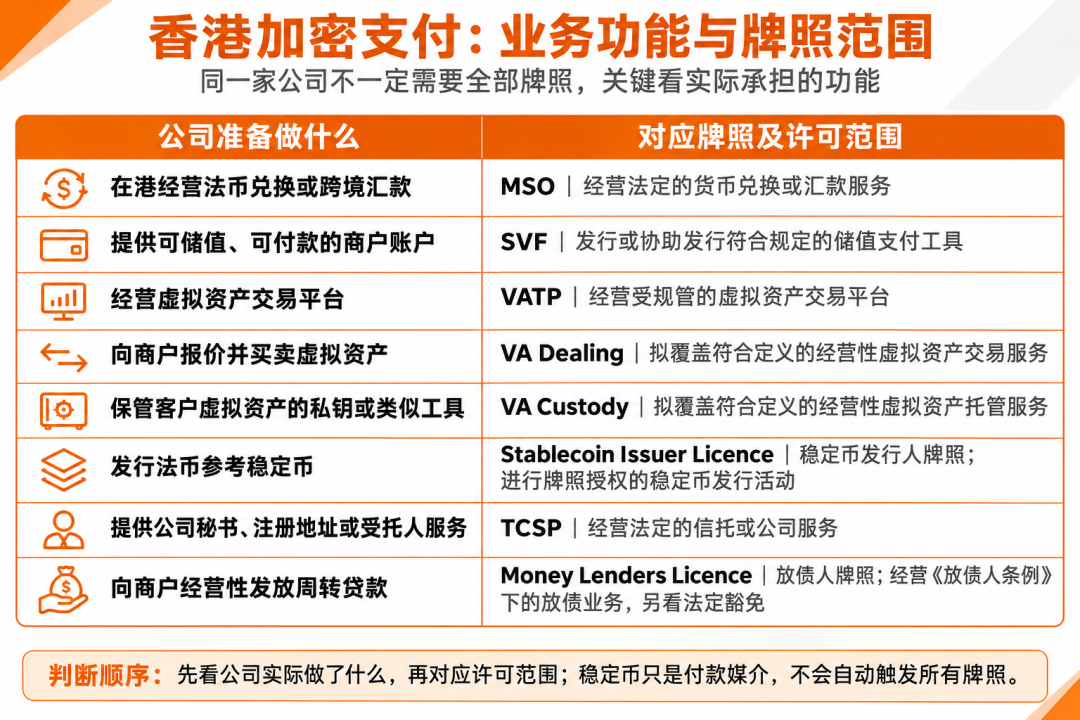
A Money Service Operator (MSO) licence concerns fiat-money exchange and remittance, including arrangements for cross-border receipts and payments. If a buyer pays in stablecoins and a merchant ultimately receives Hong Kong dollars in a bank account, the provider’s role in arranging the fiat payment needs to be assessed. Having a bank execute the final transfer does not, by itself, settle the provider’s licensing position. Nor does an MSO licence automatically authorise stablecoin trading: converting a stablecoin into Hong Kong dollars is not the same as exchanging one fiat currency for another under the MSO framework.
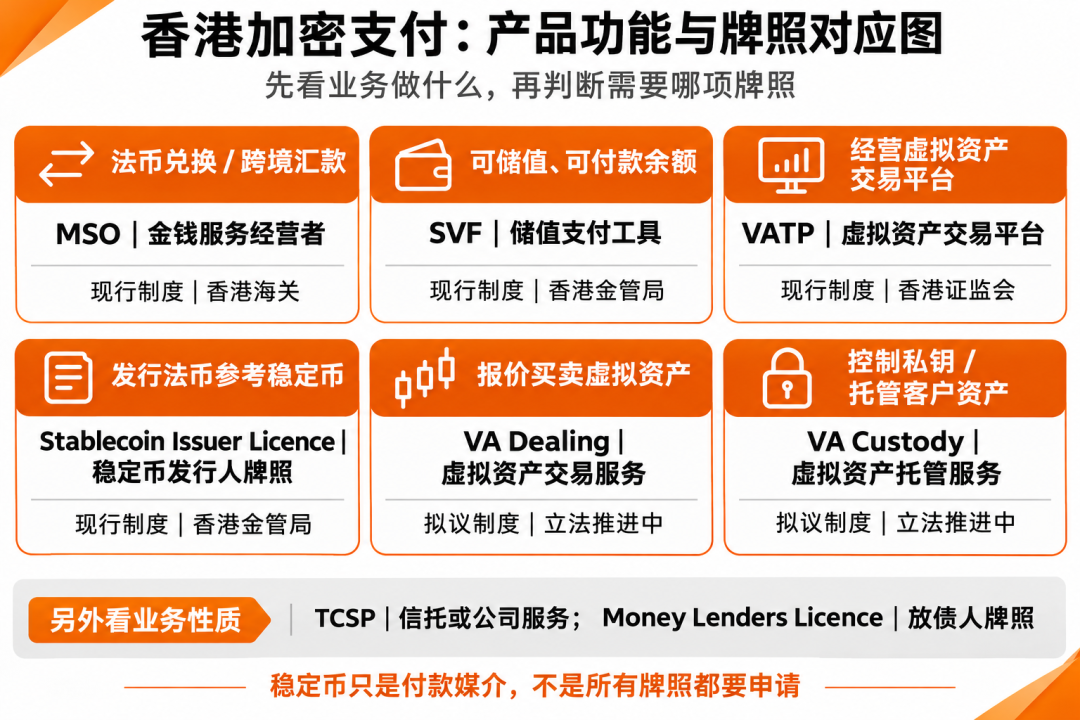
A Stored Value Facility (SVF) assessment turns on what happens after the merchant is paid. Shao distinguishes direct settlement to the merchant’s external bank account from a platform balance that the merchant can retain and use to pay third parties. The latter arrangement may bring SVF requirements into view. The analysis cites a minimum paid-up share capital of HK$25 million for an SVF applicant; it does not suggest that every payment platform displaying a balance necessarily needs an SVF licence.
Trading, issuance and control of assets
Using an existing stablecoin for settlement is different from issuing one. Hong Kong’s Legislative Council passed the Stablecoins Ordinance in May 2025, establishing a separate licensing framework for fiat-referenced stablecoin issuers. Shao describes the issuer licence as relevant to a business that issues stablecoins to the public and undertakes redemption at face value—not to a payment provider solely because it accepts a circulating stablecoin.
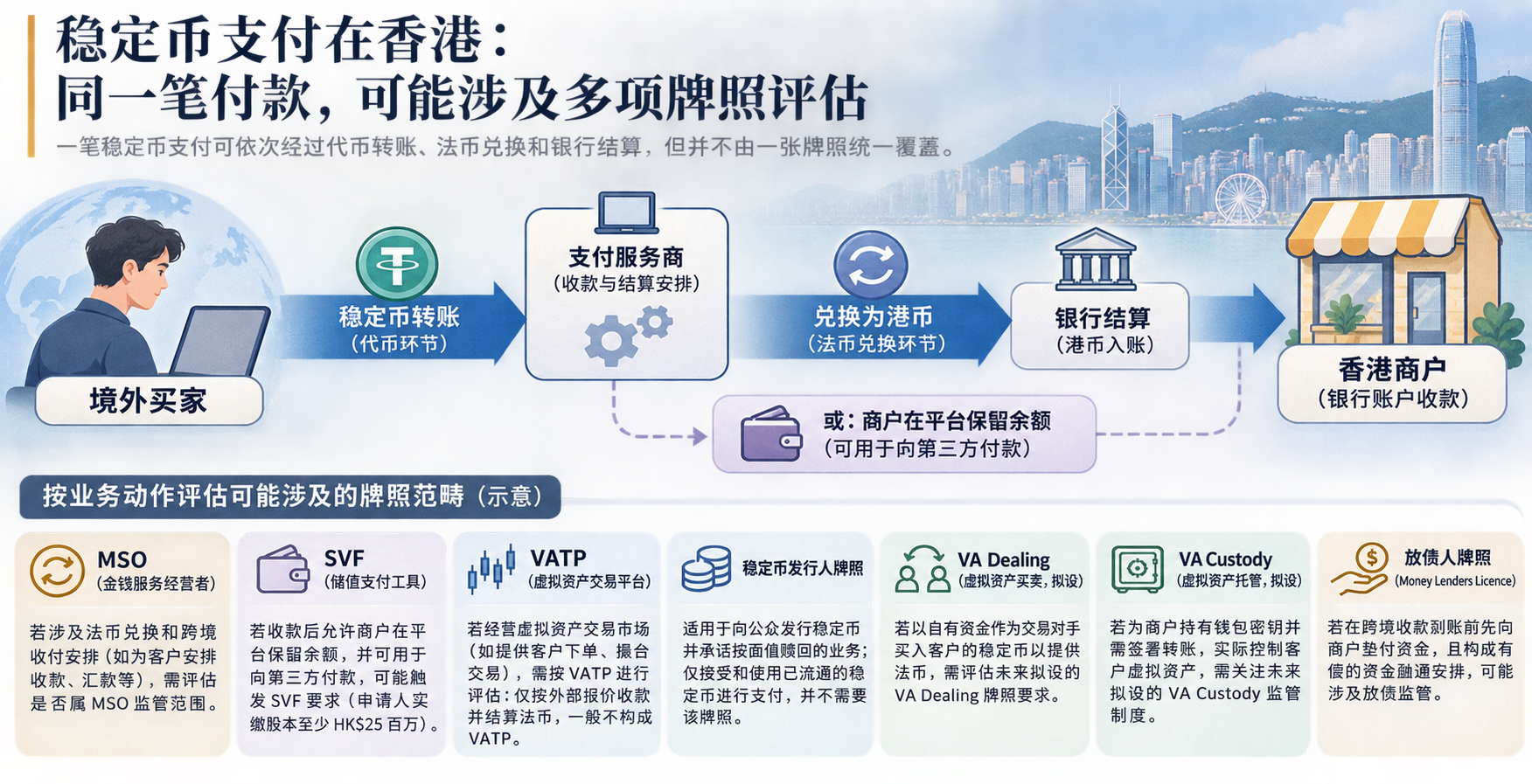
The analysis also separates a payment service from a virtual asset trading platform (VATP). A provider that accepts a stablecoin payment, uses an external quote and settles fiat to a merchant is not necessarily operating a marketplace where customers place and match trading orders. Building an internal matching system or offering the provider’s own trading quotes would require a different assessment.
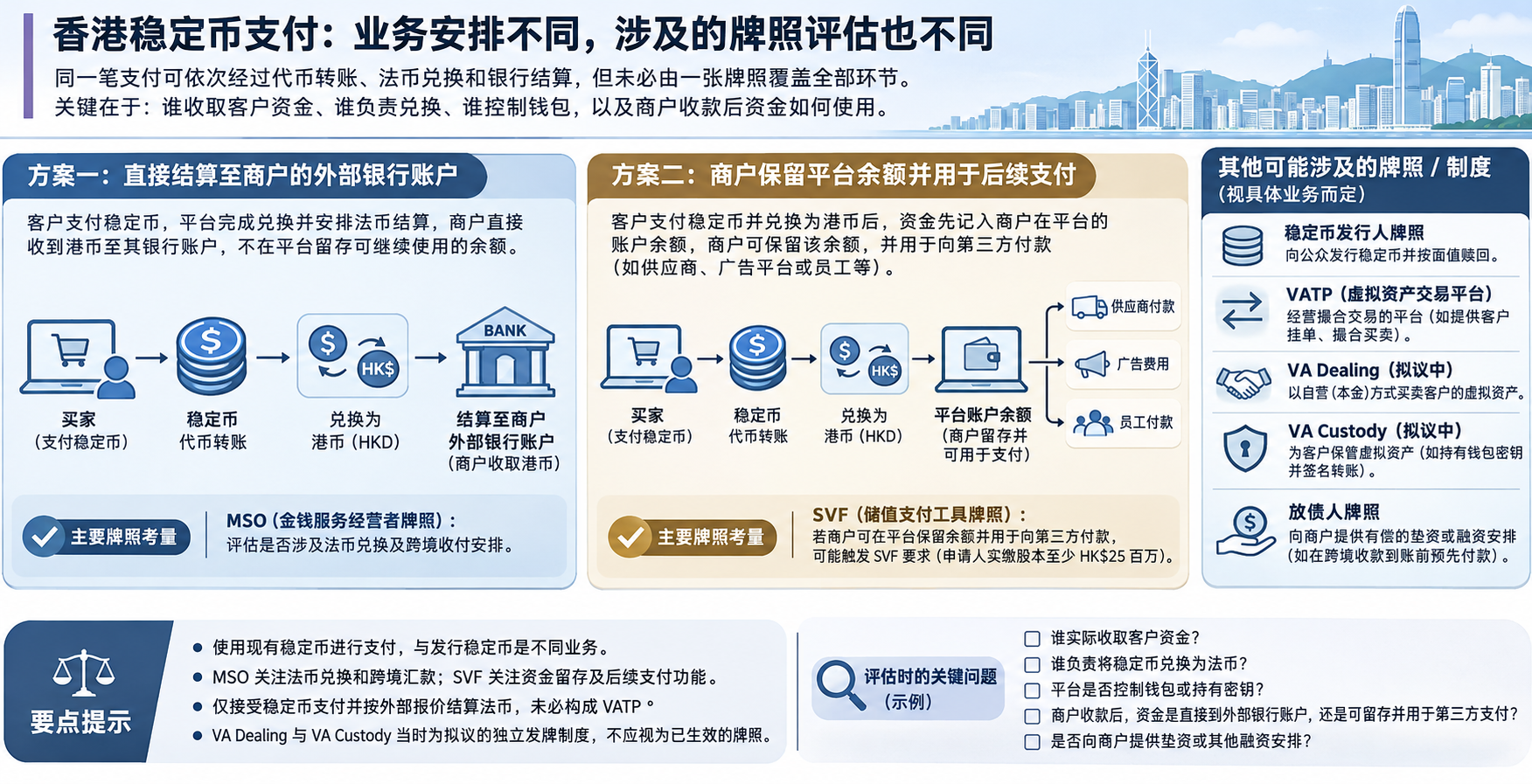
Two other activities were subject to proposed separate licensing regimes at the time of the analysis: virtual asset dealing and virtual asset custody. Shao says a provider that buys customers’ stablecoins as principal to deliver fiat may need to assess a future VA Dealing licence. A provider that holds merchant wallet keys and must sign transfers effectively controls customer assets, bringing a future VA Custody regime into view. These proposals should not be treated as licences already in force on the article’s reporting date.
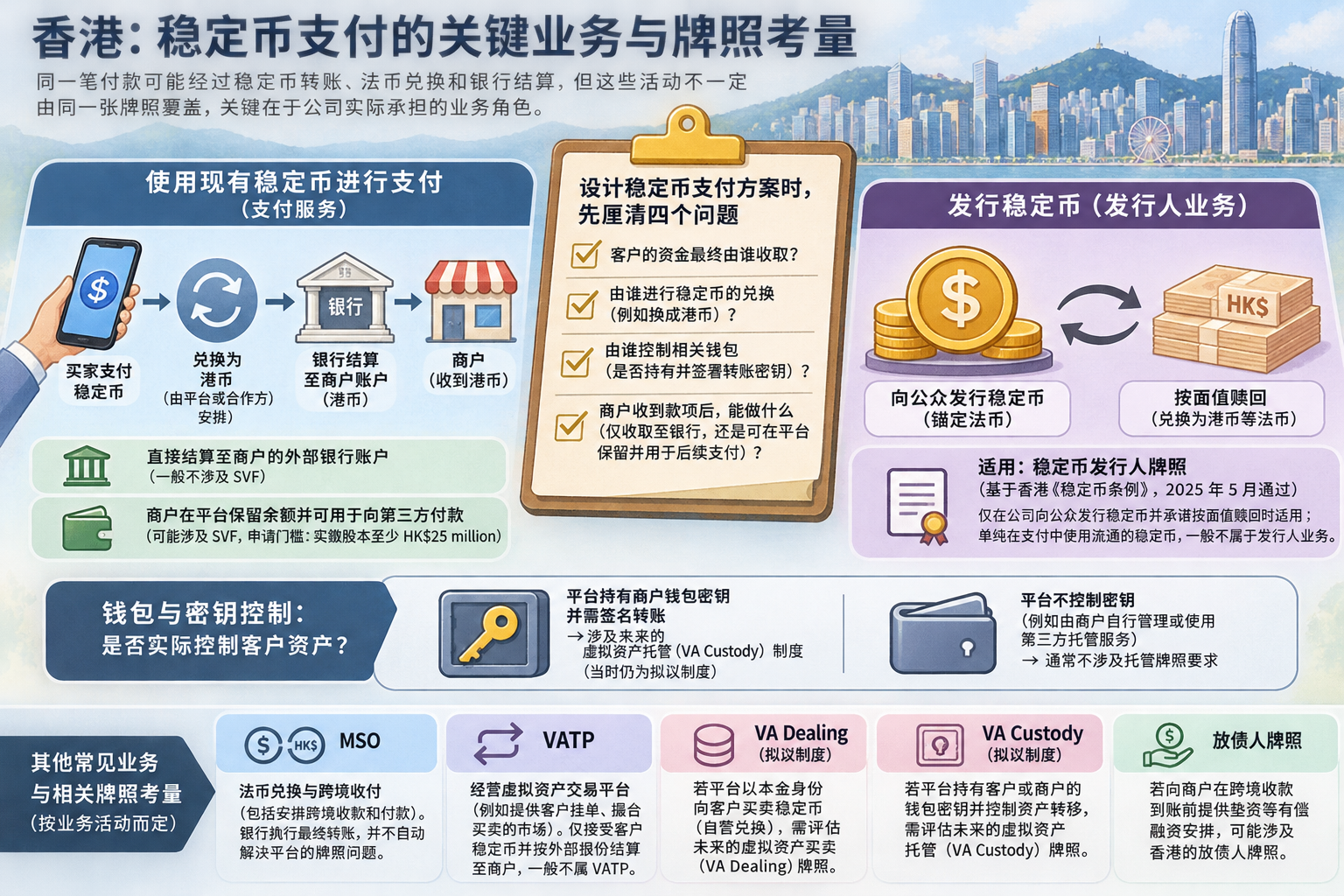
Finally, advancing money to merchants before their cross-border receipts arrive may raise money-lending questions if it becomes paid financing. Shao’s practical test is to map each movement of funds and each point of asset control, then assess the relevant activity—not to assume that a product labelled “stablecoin payments” has a single licensing answer.