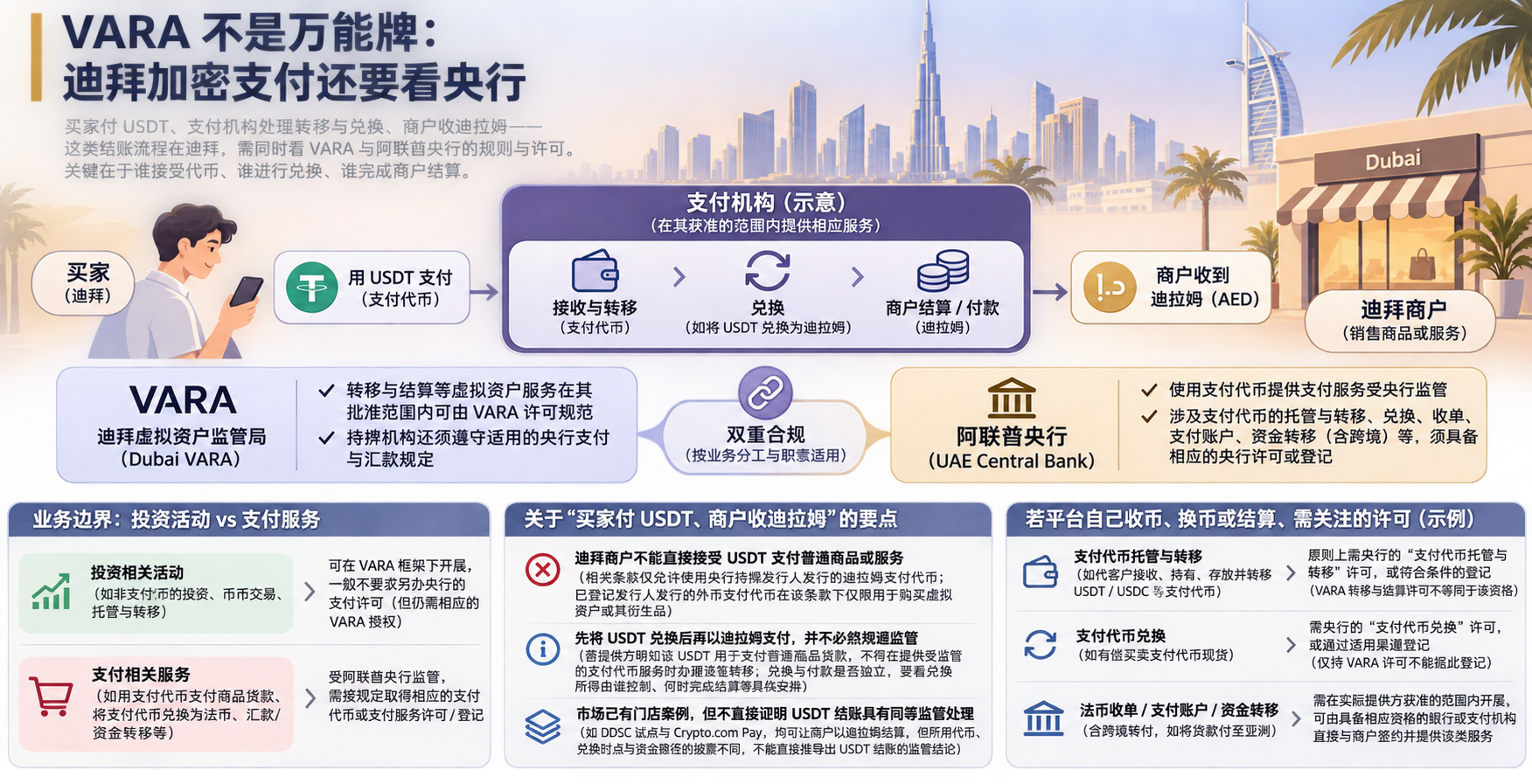
Originally reported on November 11, 2026, at 13:53 (UTC+8). In an analysis for Mankun Blockchain Legal Services, Shao Jiadian examines a proposed checkout flow: a buyer pays USDT, a payment provider converts it, and a Dubai merchant receives dirhams. The central question is not just who transfers the token, but who accepts it, converts it and settles the merchant’s payment.
The boundary between VARA and central-bank rules
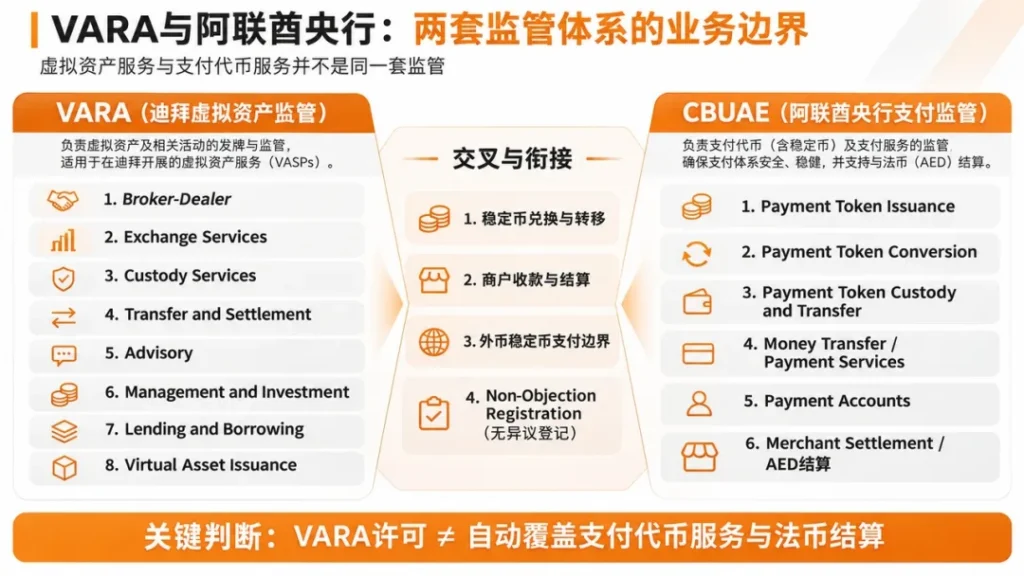
Shao explains that a Dubai Virtual Assets Regulatory Authority (VARA) transfer-and-settlement licence covers virtual-asset transfers within its approved scope; it does not, by itself, authorise every step of a merchant payment. Investment-related activity involving non-payment tokens may fall under VARA’s regime without requiring a separate central-bank payment permission, provided it does not involve payments, conversion into currency, remittances or other central-bank-regulated services. Trading, custody and transfers still require the relevant VARA authorisations.
The UAE central-bank law effective September 16, 2025, distinguishes investment activity from payment services using virtual assets. VARA rules effective June 19, 2025, also require transfer-and-settlement licensees to comply with applicable central-bank payment and remittance rules. Cross-border services must be lawful in each jurisdiction involved.
Can the buyer pay USDT if the merchant receives dirhams?
According to Shao’s reading of the central bank’s Payment Token Services Regulation, a Dubai merchant cannot directly accept USDT for ordinary goods or services under the provision discussed in the article. That provision permits such payments using dirham payment tokens issued by a central-bank-licensed issuer; it limits the cited use of foreign-currency payment tokens issued by registered issuers to purchases of virtual assets or their derivatives.
Nor does converting USDT before the merchant receives dirhams necessarily resolve the issue. Shao says the regulation prohibits a licensed or registered provider from handling a payment-token transfer when it knows the token is being used to pay for ordinary goods. A separate, compliant conversion followed by a buyer’s fiat payment must be assessed as two activities; who controls the converted funds and when the purchase is settled matter to that assessment.
The article contrasts two reported arrangements. In September 2026, Network International piloted DDSC payments at a Marks & Spencer store in Dubai Festival City, with merchants able to receive DDSC or settle in dirhams. In August 2026, Dubai Duty Free introduced Crypto.com Pay for eligible UAE residents; the merchant receives dirhams. The service provider, Foris DAX Middle East FZE, held a VARA virtual-asset services licence and a UAE central-bank stored-value facility (SVF) licence, and Crypto.com said the product was provided under the SVF licence. The Dubai Duty Free announcement did not disclose which asset each transaction debited, when conversion occurred or the full flow of funds. The two arrangements therefore do not establish that a USDT checkout has the same regulatory treatment.
Permissions depend on who performs each step
The Payment Token Services Regulation, in force since August 31, 2024, is relevant to fiat-referenced tokens such as USDT and USDC. Shao says a provider that itself holds or transfers customers’ payment tokens may need central-bank payment-token custody-and-transfer permission. A provider that itself offers covered spot conversion may need payment-token conversion permission. The regulation also provides registration routes for certain appropriately authorised custodians or virtual-asset trading-platform operators, subject to central-bank approval. A VARA transfer-and-settlement licence alone does not establish eligibility for either route.
Fiat collection, merchant acquiring, payment accounts and onward transfers—including transfers to Asia—must likewise be performed within the actual provider’s authorised scope. A qualified bank or payment firm can contract directly with the merchant to provide those services; merely using a bank account does not transfer a payment provider’s own collection and refund responsibilities to the bank. Shao advises checking who contracts with the merchant, controls wallets and accounts, receives payment instructions and is responsible if funds do not arrive.
These conclusions concern activity in the UAE and VARA’s Dubai jurisdiction as described in the analysis. The Dubai International Financial Centre is outside VARA’s jurisdiction and has a separate financial-services regime overseen by the DFSA. For the proposed checkout, the answer depends on the actual token, customer payment purpose, division of responsibilities and permissions—not on the VARA licence alone.
Source: techflowpost.com (originally published 2026-11-11 13:53 UTC+8)