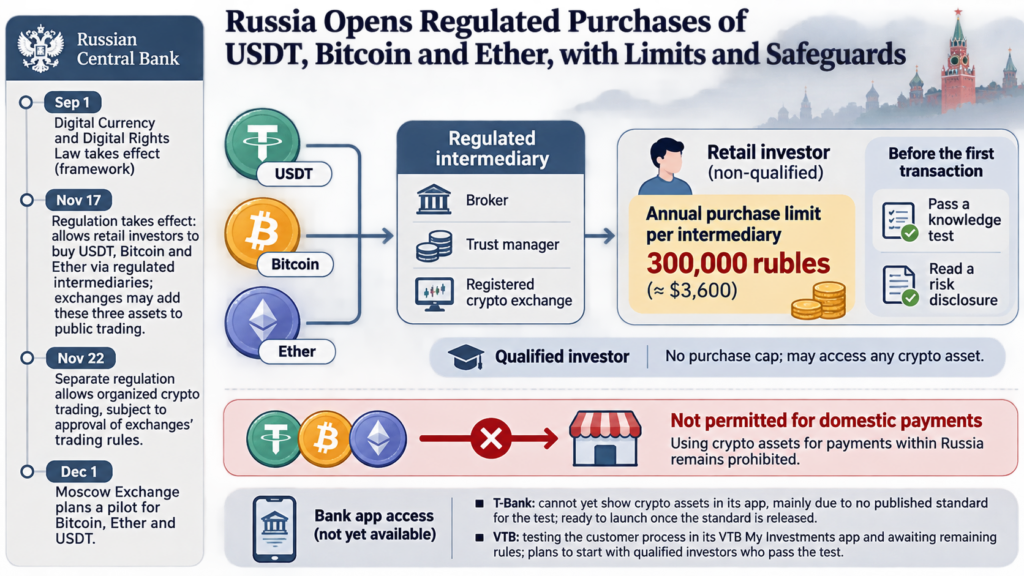
As reported on November 17, 2026, a Russian central bank regulation took effect allowing non-qualified investors to buy Tether’s USDT, Bitcoin and Ether through regulated brokers, trust managers or registered crypto exchanges. Exchanges were also permitted to add the three assets to public trading that day.
Retail investors face an annual purchase limit of 300,000 rubles—about $3,600—through a single intermediary. Qualified investors face no purchase cap and may access any crypto asset. Before their first transaction, all buyers must pass a knowledge test and read a risk disclosure.
Permission has not yet translated into bank app access. Alexander Kretov, T-Bank’s head of blockchain technology development, said customers could not yet see crypto assets in its app mainly because there was no published standard for the test. He said the bank was ready to launch customer-facing services once the central bank posted that standard. T-Bank’s crypto exchange and digital depository had been built and were in the final stage of live testing, with a phased rollout planned. VTB’s brokerage division said it was testing the customer process in its VTB My Investments app and awaiting remaining regulatory rules. It planned to start with qualified investors who passed the test.
A separate central bank regulation would allow organized crypto trading from November 22, subject to regulatory approval of exchanges’ trading rules. Moscow Exchange planned a pilot for Bitcoin, Ether and USDT on December 1. The central bank said it had limited the retail list to the most liquid assets.
The framework rests on the Digital Currency and Digital Rights Law, which took effect on September 1. It still prohibits using crypto assets for payments within Russia. Permission to purchase USDT therefore does not make it a permitted domestic payment method.